AAUP v. Rubio – Freedom of Association
- Filed: Mar 25, 2025
- Status: Active
- Court: U.S. Court of Appeals for the First Circuit
- Latest Update: Aug 13, 2026
Summary
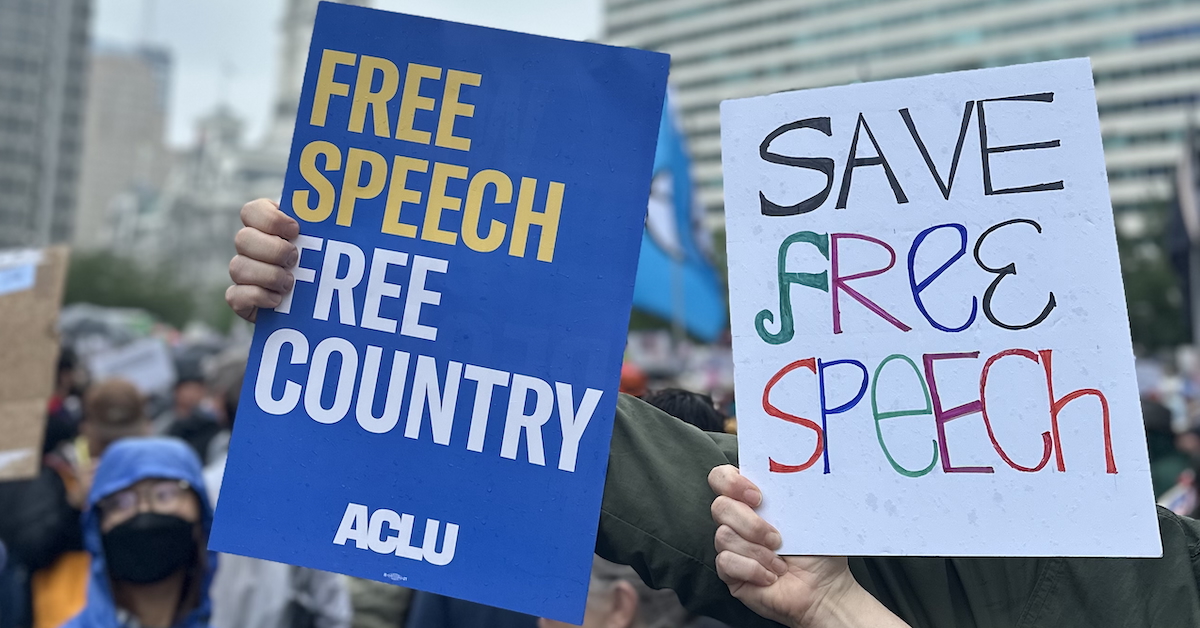
The federal government has targeted noncitizen students and faculty by arresting, detaining, and deporting them in retaliation for their pro-Palestinian activism. This is a coordinated attempt to chill their First Amendment rights to freedom of speech and assembly.
One instance was the government’s attempt to deport Mahmoud Khalil, a leader of protests at Columbia University. These actions have sent chills through the community of noncitizen students and faculty on campuses around the country, causing some to pull out of academic conferences, stay home from protests, and withdraw from other forms of public advocacy and engagement.
A trial court ruled the administration’s viewpoint-based policy unconstitutional. But the court refused to block enforcement of the policy universally, instead ordering a more limited remedy. However, any injunction limited to certain organizations’ members would require those organizations to turn over their membership lists to the government. Despite intending to limit the Trump administration’s chilling of free speech, this remedy would actually create a further chilling effect.
The ACLU of Maine and other advocates filed a friend-of-the-court brief arguing that the policy must be blocked universally to provide complete relief, ensuring that all members of the plaintiff organizations are shielded from the administration’s policy of viewpoint-based targeting. A more limited remedy that forces the organizations to divulge the names of their members would undermine the organizations’ freedom of association.
Forcing membership organizations to disclose their lists creates a chilling effect by exposing individuals to fear of government retaliation, harassment, or social and economic backlash for their beliefs. When people know their participation will be handed over to the government, they naturally engage in self-censorship and refrain from joining groups, donating, or speaking out. This violates the privacy essential to free association and silences protected speech before it even begins.
The brief was filed by the ACLU and all ACLU affiliates in the First Circuit.
The initial challenge to the administration’s policy was brought by the Knight First Amendment Institute on behalf of the American Association of University Professors (AAUP); AAUP chapters at Harvard, New York University, and Rutgers University; and the Middle East Studies Association. The groups argued that the policy chilled noncitizens from speaking and, by extension, deprived these organizations and their U.S. citizen members of noncitizens’ perspectives on a matter of significant public debate.
Documents
- Aug 12, 2026 ACLU Amicus Brief
- Aug 5, 2026 AAUP Response Brief to Appeal
- Jul 6, 2026 Federal Government Appeal
Date Filed: Aug 12, 2026
Court: U.S. Court of Appeals for the First Circuit
Affiliate: ME
Download documentDate Filed: Aug 5, 2026
Court: U.S. Court of Appeals for the First Circuit
Affiliate: ME
Download documentDate Filed: Jul 6, 2026
Court: U.S. Court of Appeals for the First Circuit
Affiliate: ME
Download document- Jan 22, 2026 Court Memorandum and Order Restricting Trump Policy
- Jan 22, 2026 Court Judgment and Order Restricting Trump Policy
- Apr 25, 2025 Federal Government Opposition
- Apr 1, 2025 Motion for Preliminary Injunction to Block Trump Policy
- Mar 25, 2025 AAUP v. Rubio Initial Lawsuit
Date Filed: Jan 22, 2026
Court: U.S. District Court for the District of Massachusetts
Affiliate: ME
Download documentDate Filed: Jan 22, 2026
Court: U.S. District Court for the District of Massachusetts
Affiliate: ME
Download documentDate Filed: Apr 25, 2025
Court: U.S. District Court for the District of Massachusetts
Affiliate: ME
Download documentDate Filed: Apr 1, 2025
Court: U.S. District Court for the District of Massachusetts
Affiliate: ME
Download documentDate Filed: Mar 25, 2025
Court: U.S. District Court for the District of Massachusetts
Affiliate: ME
Download document
Learn More About the Issues in This Case

Related Content

Harvard v. Health and Human Services – Academic Freedom
Stay Informed
Sign up to be the first to hear about how to take action.
By completing this form, I agree to receive occasional emails per the terms of the ACLU’s privacy statement.
By completing this form, I agree to receive occasional emails per the terms of the ACLU’s privacy statement.