Carson v. Makin - Separation of Church and State

  • Filed: Aug 21, 2018
  • Status: Lost
  • Court: Supreme Court of the United States
  • Latest Update: Jun 21, 2022
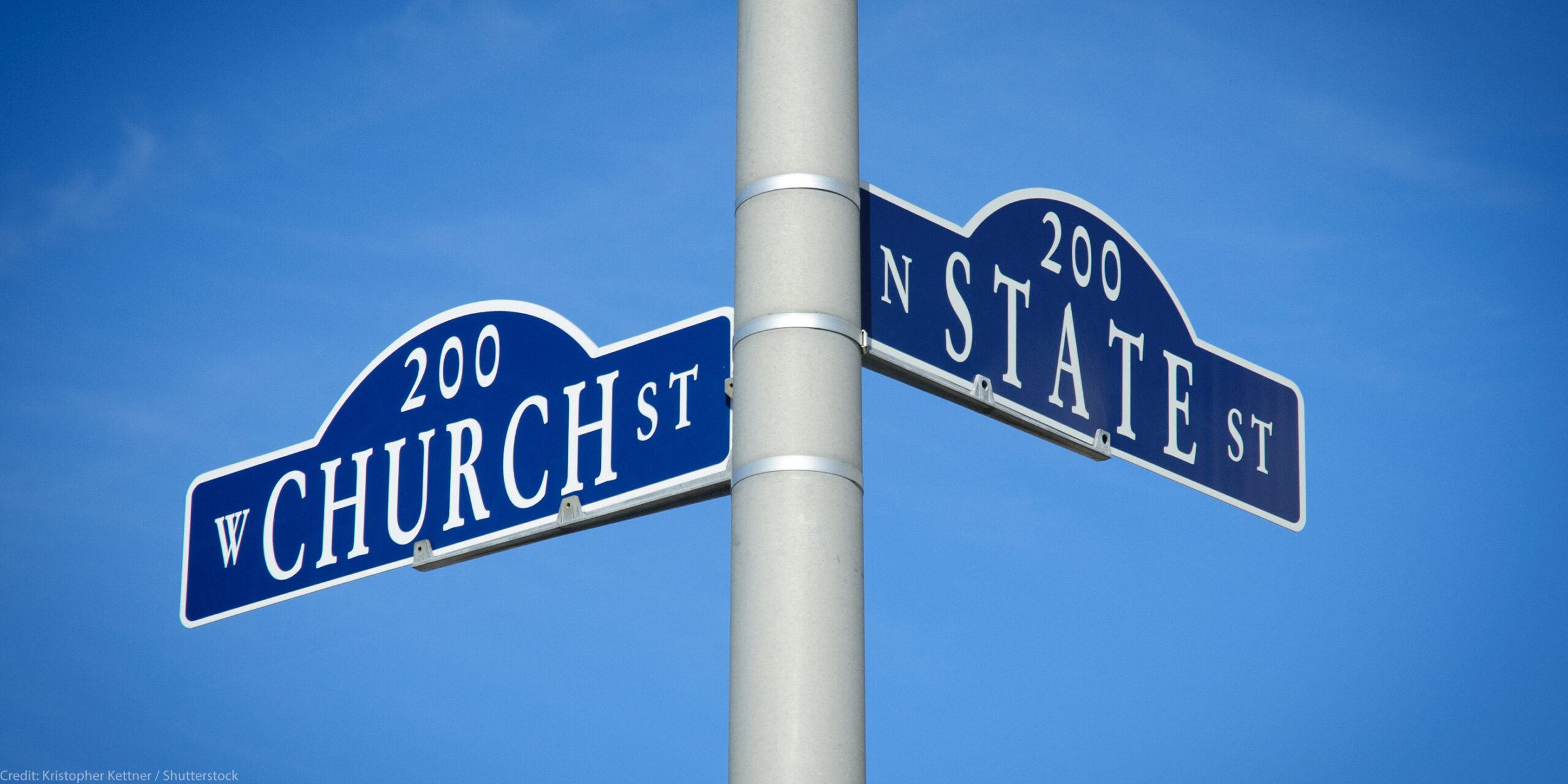
Two street signs at an intersection on a pole reading Church St on one and State St on the other.

Summary


In October 2021, we filed an amicus brief in the Supreme Court of the United States arguing that a Maine law prohibiting the use of taxpayer funding for religious instruction at religious schools was constitutional. For the first time, the Court explicitly required taxpayers to support religious education.

Maine's Tuition Assistance Program

Most students in Maine attend a public school, but some areas don’t have a public school. To ensure every child has access to a free, publicly funded education, students in school districts without their own public secondary schools can obtain public tuition assistance to attend an “approved” private school.

Maine law prohibited the use of public funding for religious instruction. Three families in Maine challenged the restriction, arguing the prohibition on tuition assistance for religious education violated the Free Exercise Clause of the First Amendment.

In our brief, we explained that under the Free Exercise Clause, the state is not required to fund religious instruction and cannot force taxpayers to fund religious beliefs they do not support. We argued that the use of public funding to support religious instruction would coerce taxpayers since they cannot entirely dictate how their tax dollars are spent.

Before this case, the Supreme Court had long held that states had a strong interest in avoiding the public funding of religious instruction.

Case Background

This case was originally filed in August 2018 by the Institute for Justice and the First Liberty Institute, which demanded that Maine’s taxpayer-funded tuition program pay for religious instruction at Bangor Christian School in Bangor and Temple Academy in Waterville. Both schools would use the taxpayer-funded tuition to teach students religious doctrine and train them in religious rites and observances.

Both schools also discriminate in admissions and employment against non-Christians and LGBTQ people. For example, Temple Academy not only prohibits gay and lesbian students, but also refuses to admit students with gay or lesbian parents. And students who come out as LGBTQ at Bangor Christian must renounce their sexual orientation or gender identity after counseling, or be expelled.

In addition, teachers at both schools must be born-again Christians “who know the Lord Jesus Christ as Savior.” And Temple Academy requires teachers to sign an employment agreement stating that “God recognize[s] homosexuals and other deviants as perverted.”

The Maine law prohibiting the use of public tuition funds at schools that teach religious doctrine had been challenged on four previous occasions, in both state and federal court. It was upheld as constitutional all four times.

The U.S. District Court for the District of Maine originally sided with the State of Maine, ruling the state could block the use of taxpayer money for religious instruction at religious schools. The U.S. Court of Appeals for the First Circuit affirmed the trial court’s ruling, noting that it had rejected similar challenges twice before.

A Blow to the Separation of Church and State

On June 21, 2022, the U.S. Supreme Court reversed longstanding precedent, ruling the restrictions on Maine’s tuition-assistance program were unconstitutional under the Free Exercise Clause of the First Amendment. This ruling established that if states implement a tuition-assistance program, they cannot exclude religious institutions.

The decision marks the first time that the Court has explicitly required taxpayers to support religious instruction and expands the Court’s 2020 ruling in Espinoza v. Montana Department of Revenue. There, the Court held that the Free Exercise Clause prohibited a state from excluding religious schools from private aid programs “solely because of their religious character.”

This erosion of the bedrock principle of separation of church and state represents a threat to the religious liberty and civil rights of all Maine people.

Case Number:
U.S. District Court for the District of Maine Docket No. 1:18-cv-327-DBH, U.S. Court of Appeals for the First Circuit Docket No. 19-1746, Supreme Court of the United States Docket No. 20-1088
Partner Organizations:
ACLU National Program on Freedom of Religion and Belief, Americans United for Separation of Church and State, Anti-Defamation League, American Humanist Association, Baptist Joint Committee for Religious Liberty, Catholics for Choice, Central Conference of American Rabbis, Evangelical Lutheran Church in America, General Synod of the United Church of Christ, Global Justice Institute, Metropolitan Community Churches, Hindu American Foundation, Interfaith Alliance Foundation, Jewish Social Policy Action Network, Men of Reform Judaism, Methodist Federation for Social Action, National Council of Jewish Women, National Council of the Churches of Christ in the USA, People For the American Way, Reconstructionist Rabbinical Association, Texas Impact, The Sikh Coalition, Union for Reform Judaism, Women of Reform Judaism

Learn More About the Issues in This Case


Related Content


Court Case
Jul 2, 2026
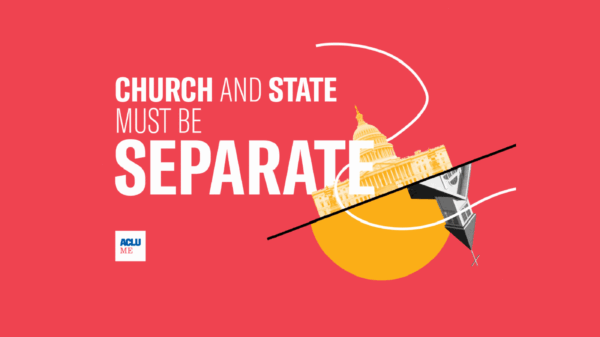
Separation of Church and State graphic
  • LGBTQ Equality|
  • +1 Issue

St. Dominic Academy v. Makin – Separation of Church and State

Crosspoint Church sought an exemption from Maine law so it could discriminate against students while receiving state funds. The right to discriminate has never been recognized by any court, and any school that wants to participate in state educational programs must play by the same rules as all others.
Court Case
Jul 2, 2026
ACLU: Share image
  • LGBTQ Equality|
  • +1 Issue

Crosspoint Church v. Makin – Separation of Church and State

Crosspoint Church, which operates Bangor Christian School, sought an exemption from state law so it could openly discriminate against LGBTQ students while receiving taxpayer education funds at the same time.