
Carvajal-Muñoz Arrest, Detention Timeline
View a detailed timeline below. Read more about this lawsuit and see legal documents here.
Carvajal-Muñoz Timeline
8:45 – 10 a.m.
Racial Profiling, Traffic Stop, & Violent Arrest
Location: Pearl Street in Downtown Portland
Juan Sebastián Carvajal-Muñoz was driving in Portland on his way to work when federal agents in an unmarked SUV with Minnesota plates cut in front of him to stop him in the middle of a downtown street. Some of the agents were wearing masks.
Carvajal-Muñoz was complying with all traffic laws and had his car's dashcam operating.
The agents surrounded his vehicle, and one of them demanded that he show them his immigration documents. Carvajal-Muñoz showed his REAL ID through the window, but the agent ordered him to step out of his car. (REAL IDs are only issued to non-citizens if they have documented lawful status.)
Carvajal-Muñoz reached for his phone to call for help and record the incident. Seconds later, the same agent smashed his window with a crowbar. A second agent – who was masked – forced his door open and dragged him out of his vehicle, as the first agent pointed a taser at him.
The agents handcuffed Carvajal-Muñoz, transferred him to the back of the unmarked SUV, and drove away. Carvajal-Muñoz was afraid for his life, especially after seeing what had happened to Renée Good in Minnesota two weeks before.
The agents left his car running in the middle of the street with the driver's side front door open. Carvajal-Muñoz's bag and keys were left on the passenger seat, and his phone was left lying in the street.
Agents targeted Carvajal-Muñoz based on his race or ethnicity and had no legal basis for the stop and arrest, which violated his Fourth and Fifth Amendment rights. When agents stopped Carvajal-Muñoz, the only information they had about him was his appearance and the fact that the vehicle was registered in his name. Agents refused to examine additional documents in Carvajal-Muñoz’s possession proving his legal status.
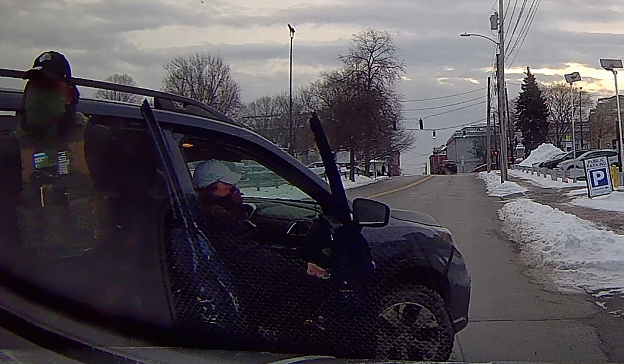
Masked agent "John Doe No. 1" and masked agent "Jane Doe No. 1" exiting the unmarked SUV to surround Carvajal-Muñoz's vehicle.
Detention in SUV
Location: Portland Area
The three agents detained Carvajal-Muñoz in the unmarked SUV and drove around Portland for over an hour.
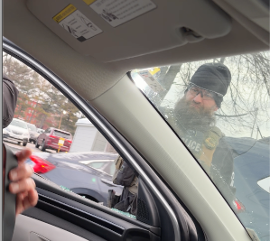
Agent Ravencamp pointing a taser at Carvajal-Muñoz through the broken driver’s side window during the stop and arrest on Pearl Street.
10 a.m. – 1 p.m.
Prolonged Detention
Location: Home Depot Parking Lot, South Portland
Agents stopped at a Home Depot in South Portland around 10 a.m.
In the Home Depot parking lot, one of the agents checked Carvajal-Muñoz's immigration status online and filled out a “Catch of the Day” online form on her laptop. (The ICE crackdown in Maine at the time was called "Operation Catch of the Day.")
Agent John Doe No. 1 took a photograph of Carvajal-Muñoz's face.
Agents Refuse to Examine Documents
Location: Home Depot Parking Lot, South Portland
Carvajal-Muñoz told the agents he had a valid H1-B visa and a copy of his Form I-94 in his wallet. John Doe No. 1 confirmed that, based on information he looked up on a database, he could see that Carvajal-Muñoz held a valid H1-B visa.
The agents took Carvajal-Muñoz's wallet but refused to look at the copy of his Form I-94.
The agents told Carvajal-Muñoz they were taking him to the ICE facility in Burlington, Massachusetts, his H1-B visa would be revoked, and he would be taken to an immigration judge in Massachusetts.
The Form I-94, issued by U.S. Customs and Border Protection, documents Carvajal-Muñoz's H1-B visa status, valid through September 2027.
Carvajal-Muñoz felt powerless and helpless. He knew he had all his paperwork and had done nothing wrong, and yet this meant nothing to the agents.
In addition to taking his wallet, agents also took his office card keys and watch.
Shackling & Transfer to Van
Location: Home Depot Parking Lot, South Portland
The agents removed Carvajal-Muñoz from the unmarked SUV and placed his feet in shackles.
Agents then transferred him to an unmarked white van.
Additional Transport
Location: Gray & Biddeford
The unmarked white van drove to a parking lot near a Dunkin’ Donuts in Gray, where additional people in shackles were loaded into the van.
At this point, there were four people in shackles in the van other than Carvajal-Muñoz. All of them were people of color.
Transfer & Additional Detainees
Location: Biddeford
At about 12 p.m., Carvajal-Muñoz and the other detainees arrived at a parking lot near the railroad tracks in Biddeford.
They were transferred to another unmarked white van, which had New Hampshire plates. There were now approximately 15 people in the van. Again, all of them were people of color.
The agents confiscated all of the detainees’ shoelaces and personal belongings. Carvajal-Muñoz and the other people in shackles were driven south toward the ICE facility in Burlington, Massachusetts.
1 – 3 p.m.
Refusal to Release Carvajal-Muñoz, Despite Instructions to Do So
Location: Kittery
Around 1 p.m., the van stopped in Kittery near the police station. Carvajal-Muñoz was seated in the front, just behind the agent driving the van.
The driver communicated with other agents on a group chat called “Maine Transportation.”
A message had popped up on the group chat asking about "Juan Carvajal’s" location. The driver asked, “Who is Juan?” Carvajal-Muñoz – whose full first and middle name is Juan Sebastián – identified himself. The driver told him, “We have good news, someone is coming for you.”
The van waited at the Kittery police station for about an hour, at which point another white van with two agents arrived to pick up Carvajal-Muñoz.
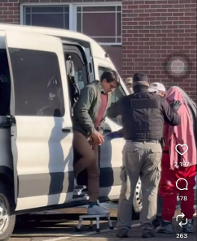
Screenshot of picture posted to social media by bystander showing Carvajal-Muñoz being transferred at Kittery police station.
Fake Return to Portland
Location: Portland
The agents drove Carvajal-Muñoz back to Portland and asked where he wanted to be dropped off. He asked to be dropped off at Lincoln Park, near the location on Pearl Street where he had been detained that morning.
The agents drove Carvajal-Muñoz near Lincoln Park, but refused to stop. Instead, they drove Carvajal-Muñoz around Portland.
Carvajal-Muñoz felt the agents were mocking him, giving him false hopes only to dash those hopes. He was humiliated.
3 – 6 p.m.
Return to Biddeford
Location: Portland, Biddeford
Between 3 and 4 p.m., the agents drove Carvajal-Muñoz back to the railroad tracks in Biddeford.
Re-Detention, Denial of Bathrooms
Location: Biddeford
At the railroad tracks, a bus was waiting with other people detained by federal agents.
An agent told Carvajal-Muñoz he needed to either cut the drawstring on his jacket or give the jacket to him. Carvajal-Muñoz gave the agent his jacket.
The agents told the detainees that if they needed to urinate before the drive to Burlington, Massachusetts, they should go in the parking lot. Carvajal-Muñoz and several other detainees urinated in public in the parking lot.
Carvajal-Muñoz felt exposed, forced to conduct one of the most private human activities in public.
Prison-Like Transport
Location: Biddeford
The agents transferred Carvajal-Muñoz to a bus that was idling in the parking lot. A number of people in shackles were already on the bus.
The bus had wire mesh on the windows and appeared to be designed for prisoner transport.
Several more people were loaded onto the bus from different white vans. Altogether, about 10 people in shackles were loaded onto the bus, along with several federal agents. Again, everyone detained was a person of color.
Carvajal-Muñoz and the other people detained and placed in shackles waited on the bus in Biddeford for several hours, until around 6 p.m.
The experience of being driven back to Portland, only to be once again driven to Biddeford, was frightening and disorienting.
6 p.m. – 12 a.m.
Arrival at Burlington ICE Facility
Location: Burlington, MA
Carvajal-Muñoz and the other detainees were driven south to an ICE facility in Burlington, Massachusetts. They arrived at about 8 p.m., nearly 12 hours after agents had first stopped Carvajal-Muñoz.
The cell had no windows, limited airflow, and no showers. There was a single toilet in the open in the cell, surrounded by a three-foot-tall divider. There were aluminum blankets, but no beds or other furniture in the cell.
After Carvajal-Muñoz was locked in the cell, agents removed the shackles.
Agents gave Carvajal-Muñoz a small portion of macaroni and cheese, the first food he had been given since he was detained that morning.
Release and Trip Home
Location: Burlington, Portland
Approximately 20 to 30 minutes after agents locked Carvajal-Muñoz in the cell, an agent asked for “Juan Sebastian.” Carvajal-Muñoz identified himself.
The agent told Carvajal-Muñoz he was “not supposed to be there,” and that he was free to go.
Carvajal-Muñoz asked the agents where his car and phone were; they did not provide any information. He was given a schedule for the Concord Coach bus to Portland. He took a cab to South Station in Boston, and then took the Concord Coach bus back to Portland – all at his own expense.
Carvajal-Muñoz arrived at the Portland bus station at around midnight, over 15 hours after he had been suddenly stopped, abducted, and detained.
Related Content