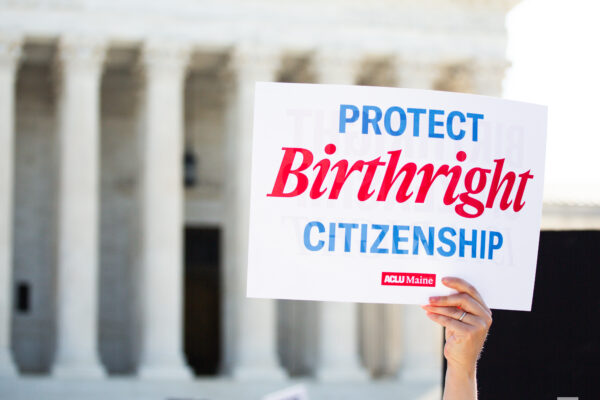

On the first day of his second term, President Trump signed an executive order attempting to end birthright citizenship, a core constitutional right guaranteed by the 14th Amendment. Hours later, the ACLU of Maine and several of our partners sued.
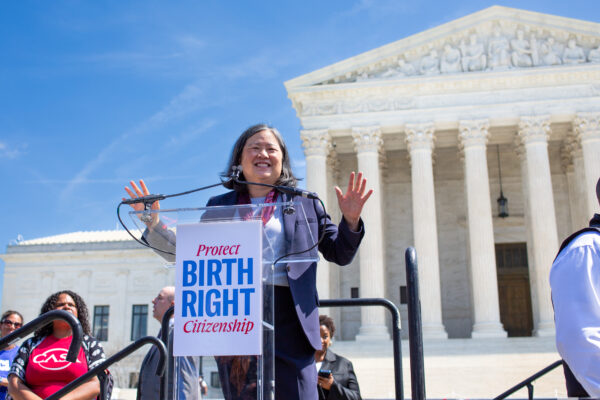
On April 1, 2026, the Supreme Court heard oral arguments in Trump v. Barbara, our case defending birthright citizenship. Together with ACLU National, ACLU affiliates across New England, and other advocates, we defended the fundamental American promise that every person born on U.S. soil is a U.S. citizen.
Our case was argued by Cecillia Wang, the national legal director of the ACLU. For over two hours, the justices considered arguments and pressed both sides with questions about the history and original intent of birthright citizenship. Here are three key takeaways from the arguments.
1. Ending birthright citizenship isn't just illegal; it's unworkable.
Ending birthright citizenship would upend over a century of tradition and legal precedent, calling into question the citizenship status of hundreds of thousands of newborns and causing staggering administrative chaos. Hospitals, federal agencies, and families across the country would be required to navigate a complex legal process just to determine who qualifies as a citizen.
What the government is proposing is a deeply flawed system that would subject every birth to legal scrutiny to prove citizenship, even as the government's own definition of citizenship may continue to shift. This is yet another stark example of the Trump administration attempting to meddle with some of the most intimate parts of Americans’ lives.
Since the ratification of the 14th Amendment in 1868, every baby born on U.S. soil has been considered a citizen. (There are very limited exceptions for the children of diplomats or hostile occupying forces.) Upending the Constitution and ending this tradition would create a permanent subclass of people born in America but stripped of the full rights and privileges of citizenship.
As Americans, we are bound by the rule of law and a commitment to a free and pluralistic society. We cannot allow a foundational constitutional right, one that has defined what it means to be American for over 150 years, to depend on the policy preferences of any single administration.
2. Ending birthright citizenship is not a partisan issue.
During oral arguments, Supreme Court justices from across the political spectrum asked the government tough questions, revealing deep skepticism about the legal basis for Trump's executive order.
This broad concern reflects what we have already seen in the lower courts. Judges appointed by presidents of both parties – including judges appointed by Trump – have uniformly struck down this order as unlawful.
3. Birthright citizenship is not a question of policy, it's a question of constitutional interpretation.
No administration has the authority to use its own policy preferences to rewrite the Constitution and restrict its fundamental rights and guarantees. As ACLU National Legal Director Cecillia Wang stated in her opening argument, the 14th Amendment's guarantee of birthright citizenship was enshrined in our Constitution to "put it out of the reach of any government official to destroy."
Our Constitution has meaning and value, and that meaning cannot be rewritten with the stroke of a president’s pen.
The justices' questioning was revealing. Regardless of the Trump administration's views on immigration, the Constitution is clear: every baby born on U.S. soil is a U.S. citizen. More than 150 years of precedent, congressional debate, and legal history reaffirm this principle. The law of the land must be followed.
You can read more about the history of our case here. The Supreme Court is expected to issue a decision in Trump v. Barbara in June or July. We will keep you updated.